
Understanding Spine VA Disability Ratings
Military life is incredibly tough on the human skeleton. Marching long distances with heavy packs, driving bumpy tactical vehicles, lifting heavy gear, and working on concrete flight lines wear down the spine over time. These activities change your body’s natural biomechanics, which is how your muscles and joints balance your weight when you move.
When you apply for disability benefits, the VA does not give you a rating based only on the name of your illness. Instead, they look at your functional limitation. This means they measure how much your injury stops you from bending and moving normally.
Your medical records need to prove this. Good records look past basic statements like “my back hurts” and write down exact details:
- The precise angles or degrees you can safely bend, twist, or turn your neck and back.
- Clear physical signs the doctor can see, like stiff muscle spasms or a limp when you walk.
- How often you suffer from sudden, severe flare-ups and how long they last.
- How your back pain hurts your daily routine, like your ability to sit, stand, lift things, or sleep through the night.
The Three Regions of the Spine
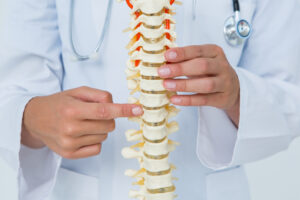
To evaluate your back, federal rules group the bones of your spine into distinct sections. The spine is evaluated in two main segments: the cervical spine (neck) and the thoracolumbar spine (mid and lower back, combined for rating purposes).
| Spine Region | Anatomical Area | Common Documented Conditions |
| Cervical Spine | Neck (Vertebrae C1–C7) | Neck strains, worn-out discs, pinched nerves |
| Thoracolumbar Spine | Mid to Lower Back (Vertebrae T1–L5) | Muscle pulls, narrow spinal canals, slipped discs. |
Your neck and your lower back twist and bend the most. Because they do the most work, they take the most abuse during military service. That is why they are the most common areas found in veterans’ medical files.
Common Spinal Conditions Found in Medical Evidence
When medical experts review your files, they look for specific names that describe what is wrong with the structure of your spine:
Lumbar Strain (Diagnostic Code 5237)
This is a stretch or a tear in the muscles or ligaments of your lower back. It can happen from a sudden accident or from years of heavy lifting. It usually causes a deep ache, stiff muscles, and makes it very hard to bend forward.
Degenerative Disc Disease / DDD (Diagnostic Code 5242)
Spinal discs are the fluid-filled cushions between your backbones. Over time, heavy physical work causes these discs to dry out, wear down, and flatten. According to official VA reports, these types of worn-out bone and muscle conditions are the number one physical problem facing modern veterans today. When a disc flattens, your bones rub together, causing painful swelling and pinched nerves.
Intervertebral Disc Syndrome / IVDS (Diagnostic Code 5243)
This happens when a disc bulges or slips completely out of place and presses hard against a nerve. IVDS causes sudden, sharp, shooting pains. For this specific condition, the VA can skip the usual bending tests and rate you based on how many weeks of bed rest a doctor ordered to help you survive severe flare-ups.
Spinal Stenosis (Diagnostic Code 5238)
This is a progressive narrowing of the open spaces inside your backbone where your nerves travel. When these spaces shrink, they squeeze your spinal cord and nerves. Veterans with stenosis often feel weak legs, numb feet, or an uncomfortable burning feeling when they stand or walk for a long time.

The Spine Rating Formula (38 CFR § 4.71a)
Unless your rating is based on ordered bed rest for a slipped disc, the VA rates all back problems using a standard movement chart. The examiner uses a tool called a goniometer (a special plastic protractor) to measure the exact angles you can bend.
The table below shows the official federal rating levels based on how far you can move:
| VA Rating | Thoracolumbar Spine (Mid to Lower Back) | Cervical Spine (Neck) |
| 10% | You can bend forward between 61° and 85° OR your total combined movement in all directions is between 121° and 235°. (This is also given automatically if it hurts to move). | You can bend forward between 31° and 40° OR your total combined movement in all directions is between 171° and 335°. (This is also given automatically if it hurts to move). |
| 20% | You can only bend forward between 31° and 60° OR you have severe muscle stiffness that changes how you walk or stand. | You can only bend forward between 16° and 30° OR severe muscle stiffness noticeably twists your neck out of line. |
| 30% | Not allowed using movement scores. (Only given if a doctor orders 4 to 6 weeks of bed rest for IVDS). | You can only bend forward 15° or less OR your whole neck segment is completely frozen in a straight position. |
| 40% | You can only bend forward 30° or less OR your whole lower back segment is completely frozen in a straight position. | Your entire neck segment is completely frozen and locked at an abnormal, painful angle. |
| 50% | Your entire lower back segment is completely frozen and locked at an abnormal, painful angle. | This specific percentage level is not used for the neck. |
| 100% | Complete Spinal Fusion: Your entire spine (neck, mid-back, and lower back) is completely frozen and locked tight at an awkward, rigid angle. | Complete Spinal Fusion: Your entire spine (neck, mid-back, and lower back) is completely frozen and locked tight at an awkward, rigid angle. |
The Critical Legal Definitions of Ankylosis
If your back is so injured that the bones have fused together or turned to solid scar tissue, the VA calls this ankylosis (frozen joints).
- Favorable Ankylosis: Your spine segment is completely frozen and cannot move, but it is locked in a normal, straight-up-and-down position.
- Unfavorable Ankylosis: Your spine segment is completely frozen, but it is locked at an awkward, bent, or twisted angle. This makes it very hard to see straight, keep your balance, or move your body.
The Rule Against Double-Rating (Pyramiding): You cannot get two separate movement ratings for the same section of your back. For example, if you have both muscle strain and worn-out discs in your lower back, the VA combines them into one single lower back rating. However, any nerve damage caused by your back can be rated separately.

Functional Loss and the “Painful Motion” Rule
Many veterans worry that if they have a physical exam on a “good day,” the VA will think their injury isn’t serious. Federal law protects you from this. The VA is required to look at your total functional loss over time, not just a single moment in a quiet clinic.
Your medical file should show how your back works when you are tired, under stress, or suffering through a terrible flare-up.
The Painful Motion Rule (38 CFR § 4.59)
This rule found on the Code of Federal Regulations states that if a joint hurts to move, it is officially an impaired joint. If your medical records or your physical exam prove that moving your neck or back causes you pain, the law says you must receive at least the minimum 10% rating for that section.
This protection applies even if you can bend all the way forward normally on the day of the test; if it hurts to do it, you qualify for the rating.

Secondary Service Connection: The Spinal Domino Effect
A severe back injury rarely stays in one place. Because your spine holds up your body and protects your nervous system, a back injury often starts a chain reaction that damages other parts of your body.
1. Changed Biomechanics (The Walking Domino)
When bad lower back pain forces you to limp or lean to one side, you change your center of gravity. This uneven weight pushes too hard on your other joints. Over time, this extra stress can cause painful arthritis or tissue damage in your hips, knees, and ankles.
2. Pinched Nerves (The Nerve Domino)
When your discs flatten out or bone spurs grow, they can squeeze the nerves leaving your spinal cord. This causes painful nerve damage:
- Lumbar Radiculopathy (Sciatica – Code 8520): A squeezed nerve in your lower back sends sharp, shooting pain, burning, or numbness down through your buttocks, thighs, calves, and into your feet. It can also make your legs buckle.
- Cervical Radiculopathy (Code 8510): A squeezed nerve in your neck causes constant tingling, loss of feeling, or a weak handgrip that moves down your shoulders, arms, and fingers.
3. Living with Constant Pain (The Quality of Life Domino)
Dealing with severe, unceasing back pain exhausts your health and well-being:
- Sleep Problems: Sharp nerve pain or muscle spasms can make it impossible to get comfortable at night, leading to chronic insomnia (severe sleeplessness).
- Mental Health Struggles: Fighting severe physical pain every single day wears down your mental energy, which can lead directly to secondary anxiety or depression.
Take Control of Your Records
If you need help organizing your medical history, you can reach out to the specialists at Trajector Medical for a professional review of your records. Our team helps you find missing pieces in your charts and arrange your evidence so your current health status is clearly framed.
Note: We provide medical evidence consulting to help you understand your documentation. We do not file claims, fill out paperwork, or represent veterans before the VA. You are in control of your evidence and your benefits journey.