
Why Your VA Rating Decision Letter Matters in 2026

VA Rating Decision Letter importance

Article Summary

Your VA Rating Decision Letter is the “roadmap” of how the VA viewed your medical records. 

  • It lists what evidence was used and, more importantly, what might be missing. 
  • Understanding the “Reasons for Decision” may help you see gaps in your medical documentation. 
  • Medical evidence consulting can help clarify your health history without the stress of filing paperwork.
Why Your VA Rating Decision Letter Matters in 2026

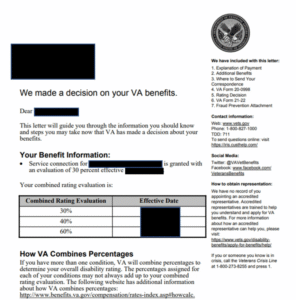
When you reach a milestone in your benefits journey, the U.S. Department of Veterans Affairs (VA) sends you a VA Rating Decision Letter. For many veterans, this document is confusing. However, understanding the VA Rating Decision Letter importance is one of the best ways to stay in control of your health and benefits pursuit. 

In 2026, the VA continues to update how it evaluates certain conditions. This makes your decision letter even more valuable. It is not just a notice of a “yes” or “no.” It is a detailed look at how the VA sees your medical history. 

What is a VA Rating Decision Letter?

Think of this letter as a “report card” from the VA. It tells you their final decision after they review your information. The letter usually includes: 

  • The Decision: What percentage was potentially assigned to each condition. 
  • The Evidence: A list of the medical records and papers the VA looked at. 
  • Reasons for Decision: The “why” behind their choice. 
  • Favorable Findings: Facts the VA agreed were true, even if they didn’t grant everything. 


Note:
 We are medical evidence consultants. We do not file claims, handle paperwork, or provide legal advice. Our goal is to help you understand what your medical records say so you can decide your own next steps. 
Diagnosis vs. Service Connection: Why Both Matter

A common point of confusion is the difference between a medical diagnosis and “service connection.” 

  • Medical Diagnosis: This is a doctor saying you have a specific health issue, like a back injury or a breathing problem. It is a medical fact. 
  • Service Connection: This is the VA deciding if that health issue was caused or made worse by your military service. This is an administrative decision. 


You can have a solid diagnosis from a doctor, but the VA may still decide there isn’t enough evidence to link it to your service. Your decision letter will explain if the VA found a “nexus” (a link) between the two.
 

Feature  Medical Diagnosis  VA Service Connection 
Who makes it?  A Medical Doctor  The VA 
What does it prove?  That you are sick or hurt  That it happened because of service 
Evidence used  Exams, X-rays, Tests  Medical records + Military records 

The “Domino Effect” in Your Health 

Sometimes, one health issue leads to another. We call this the “Domino Effect.” In the VA world, this is known as a secondary condition. 

Imagine a row of dominoes. The first domino is your main injury (like a knee problem). Because your knee hurts, you walk differently. Over time, that change in how you walk causes back pain. 

  1. First Domino: Knee injury (Primary). 
  2. Second Domino: Back pain caused by the knee (Secondary). 


Your VA Rating Decision Letter might show that the VA saw the first domino but missed the second one. High-quality medical documentation can potentially show how these “dominoes” are connected.



How to Find and Read Your Letter

Possibly the easiest way to get your letter is online. 

  1. Log in to VA.gov: Use your ID.me or Login.gov account. 
  2. Go to “Disability”: Look for the “Check Your Decision Status” tool. 
  3. Download PDF: Most veterans can see their letters here 7 to 10 days before they arrive in the mail. 


Where to focus your eyes:
 Skip to the “Reasons for Decision” section. This is the heart of the letter. If the VA says they “did not find a link to service,” it may mean your medical records weren’t clear enough. This is where medical evidence consulting may be able to help. 

Why We Ask for Your Decision Letter

At Trajector Medical, we ask to see your letter because it tells us exactly what the VA is thinking. By reviewing the VA’s own words, we can help you find: 

  • Missing Evidence: Did the VA miss a key doctor’s note you sent? 
  • Medical Nuance: Did the VA use a generic description for a very specific health issue? 
  • Clarification Gaps: Do your current records clearly explain your symptoms? 


You are always in the driver’s seat.
 We provide the medical insights, but you decide if or how you want to use them in your benefits journey. We do not “prep” you for exams; we educate you on what the medical records show. 

Your benefits journey is personal. The VA Rating Decision Letter importance lies in its ability to show you the path forward. By focusing on strong medical evidence and clear documentation, you can potentially provide the VA with the full picture of your health. 

Would you like us to help you look at the medical evidence in your decision letter?

Green Checkmark

Article Medically reviewed by Paige Polakow, President, Trajector Medical

Paige Polakow headshot

Strong medical documentation. Clear evidence.

Connect with our licensed specialists today.

Tips for Veterans

Navigating the VA claims process can be challenging, but these tips can simplify your journey.

  • Maintain Medical Records: Keep detailed records of all treatments and symptoms.
  • Seek Medical Opinions: Ensure your doctor provides a clear link between your primary and secondary conditions.
  • Be Persistent: Many claims are approved after appeals.


Understanding and claiming VA benefits for secondary conditions can seem daunting, but you’re not alone. With proper medical evidence, support from accredited representatives, and persistence, you’re positioned to secure the benefits you deserve.

Discover how our medical evidence service is transforming lives

Clear and concise medical documentation is crucial for the success of any disability claim. If you’re unsure about your documentation, talk to one of our licensed medical experts for FREE.

And know that at the heart of everything we do at Trajector Medical are the stories of our clients. We are proud to say that we have surpassed 1,000 recorded testimonial videos on our YouTube Channel. Real people that we have helped by building supporting medical evidence that they used to pursue the disability benefits they choose.

Smiling nurse in blue scrubs with clipboard

Strong medical documentation. Clear evidence.

Connect with our licensed specialists today.

Related FAQs:

How long does it take to get a decision letter?

As of late 2025 and early 2026, the average time for a decision is about 100 to 140 days. Once the decision is made, you can usually download it online within a few days.


What is a “Favorable Finding”?

Even if the VA denies a connection, they might list “Favorable Findings.” This means they agree on some facts—like that you were in a specific place or that you have a certain diagnosis. This saves you from having to prove those parts again later.


Can the VA change my rating in 2026?

The VA may update its rules (like for sleep apnea or mental health). However, a decision letter from the past stays part of your permanent record. New medical evidence may help the VA look at your situation again under current rules.


What is the “Reasons for Decision” section?

This is the most important part of your letter. It explains the VA’s logic. It lists the medical facts they used and the rules they followed. If a benefit was not granted, this section tells you what was missing.


*Trajector Medical is not an accredited attorney or agent and does not represent veterans before the VA. This article is provided as information only. For more information, see the Department of Veteran’s Affairs FAQs at https://www.va.gov/disability/how-to-file-claim/ or consult with a VSO or other accredited representative. For expert medical evidence development in support of your VA claims, contact Trajector Medical today.

Related Articles

VA secondary conditions

VA Secondary Conditions: The Domino Effect Guide (2026)

Why Secondary Conditions Matter More Than Ever Each year, the Department of Veterans Affairs (VA) updates how it evaluates disability claims. These updates include Cost of Living Adjustments (COLA) and...

Read More…

Medical documentation

Medical Documentation: Support Severity and Chronicity

A diagnosis, the official name of a health condition, is the first piece of medical evidence. But for a full look at a veteran’s situation, the paperwork must go deeper....

Read More…

VA decision deferred

My VA Decision Was Deferred: Is This a Denial in Disguise?

If you opened your mail to find your VA decision was deferred, your first reaction might be frustration. After months of waiting, it can feel like you are being told...

Read More…