Understanding Lumbar Strains
Almost everyone experiences lower back pain at some point in their life. But for veterans, a lower back injury is often more than a temporary ache. Years of heavy lifting, repetitive physical demands, high-impact training, or prolonged exposure to vibration and rough terrain may contribute to chronic lower back symptoms in some individuals.
Your lower back is known as the lumbar spine. It consists of five large bones (labeled L1 through L5) that carry the weight of your upper body.
To keep you upright and allow you to twist and bend safely, these bones are surrounded by a network of paraspinal muscles and tough, fibrous bands called ligaments.
What is a Lumbar Strain?
A lumbar strain is an injury to the muscles or tendons in the lower back caused by overstretching or tearing. It typically results in pain, stiffness, muscle spasms, and reduced mobility in the lumbar spine.
In routine clinical practice, lumbar strains and lumbar sprains are often discussed together because they produce similar symptoms and functional limitations. Symptoms and underlying causes can vary significantly from person to person. Some individuals may experience ongoing pain, stiffness, or reduced function that impacts daily activities.
What Are the Symptoms of a Lumbar Strain?
According to clinical resources from the American Academy of Orthopaedic Surgeons (AAOS) and the National Institutes of Health (NIH), a lumbar strain can present with several distinct physical characteristics.
These symptoms can fluctuate in severity depending on your activity levels, flare-ups, and rest.
| Common Symptom | Description |
| Localized Pain | Pain centered in the lower back that may intensify with movement or lifting. |
| Stiffness | Difficulty moving normally, especially when transitioning from sitting to standing. |
| Muscle Spasms | Involuntary tightening or cramping of the paraspinal muscles. |
| Tenderness | Localized sensitivity to touch along the muscles flanking the spine. |
| Reduced Mobility | Difficulty bending forward, leaning backward, or twisting comfortably side to side. |

How Is a Lumbar Strain Diagnosed?
Healthcare professionals typically use a multi-step process to diagnose a lower back strain and rule out other potential structural issues within the spinal column. An evaluation generally includes:
- Medical History: A review of how and when the back pain started, past physical activities, and how the symptoms impact daily tasks.
- Physical Examination: Palpation (feeling the muscles) to check for swelling, structural warmth, tenderness, or tightness.
- Range-of-Motion Testing: Evaluating the flexibility of your lower back across different bending pathways using standard range of motion markers.
- Neurological Screening: Checking deep tendon reflexes, muscle strength, and sensation in the lower extremities to evaluate if nerve roots are involved.
Objective vs. Subjective Medical Evidence
When medical evidence is reviewed, documentation is often divided into two primary categories: subjective reports and objective findings. A complete record should ideally show both.
| Evidence Type | Medical Record Focus | Clinical Examples in Charts |
| Subjective Claims | Personal descriptions of symptoms, pain intensity, and personal comfort levels. | “My lower back throbs constantly, and it hurts whenever I try to bend over to tie my boots.” |
| Objective Findings | Measurable physical signs observed, felt, or calculated by an examiner during a physical test. | “Doctor observes a forward flexion limit of 50°, accompanied by visible paraspinal muscle spasms.” |
Lumbar Strain vs. Herniated Disc
Lower back conditions can stem from different anatomical structures. Healthcare providers distinguish between soft-tissue limitations and structural disc injuries during clinical evaluations:
| Feature | Lumbar Strain | Herniated Disc |
| Primary Pathology | Muscle, tendon, or ligament injury. | Disruption of the intervertebral disc structure. |
| Pain Distribution | Pain is often localized to the lower back and buttocks. | May include radiating pain, numbness, or tingling down the leg (sciatica). |
| Diagnostic Focus | Usually diagnosed through physical exam and functional findings. | Often evaluated using advanced diagnostic MRI imaging. |
| Clinical Signs | Commonly involves localized spasms and muscle stiffness. | May involve nerve root compression, reflex changes, or muscle weakness. |
VA Disability Rating Mechanics for the Spine
When a veteran navigates their benefits journey, vague phrases like “my back is always stiff” do not provide enough clinical depth. Instead, the focus is on standardizing functional loss.
VA disability ratings for the spine are based on specific range-of-motion thresholds defined in 38 CFR § 4.71a, along with factors such as ankylosis (abnormal stiffening and fixation of a joint), muscle spasm, and abnormal gait. Forward flexion of the thoracolumbar spine is one of the primary measurement points used in the rating formula.
Range of Motion (ROM) Thresholds
A healthcare provider or examiner will use an instrument called a goniometer (the medical standard for measuring joint angles) to record your exact degrees of movement. Movement is tracked across multiple directions (flexion, extension, lateral flexion, and rotation).
Under the General Rating Formula for Diseases and Injuries of the Spine, forward flexion of the thoracolumbar spine (mid and lower back) generally aligns with the following evaluation thresholds:
- Forward flexion greater than 60 degrees but not greater than 85 degrees; or a combined range of motion of the thoracolumbar spine greater than 120 degrees but not greater than 235 degrees; or muscle spasm, guarding, or localized tenderness not resulting in abnormal gait or abnormal spinal contour may correspond to a 10% evaluation.
- Forward flexion of the thoracolumbar spine greater than 30 degrees but not greater than 60 degrees; or the combined range of motion of the thoracolumbar spine not greater than 120 degrees; or muscle spasm or guarding severe enough to result in an abnormal gait or abnormal spinal contour may correspond to a 20% evaluation.
- Forward flexion of the thoracolumbar spine 30 degrees or less; or favorable ankylosis of the entire thoracolumbar spine corresponds to a 40% evaluation.
Lower levels of limitation or a full range of motion without alternative structural findings may correspond to a noncompensable (0%) rating depending on the full clinical picture documented in the exam.
The “Domino Effect” and Secondary Conditions
A chronic back injury rarely stays isolated to just the muscles in your lower spine. Over time, a lumbar strain can trigger what is commonly referred to as a “Domino Effect.” This occurs when a primary physical condition causes your body to overcompensate, potentially leading to new, secondary medical issues over time.
Altered Body Mechanics
When you experience severe back pain, you naturally alter how you move. You might favor one side, walk with a shortened stride, or slouch to take the pressure off your lower back.
This constant overcompensation forces your hips, knees, and ankles to absorb weight unevenly. Over months or years, these changes in movement patterns caused by chronic lower back pain may contribute to increased stress on surrounding joints, potentially accelerating wear and tear.
Building Your Medical History Timeline
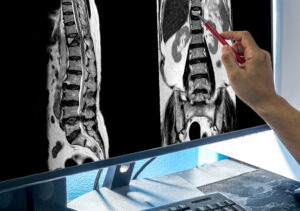
Because a lumbar strain is an injury localized within soft tissues, advanced imaging files like MRIs or X-rays might actually come back looking relatively normal, or only show minor wear and tear. This may be one reason why establishing a long-term treatment history is important.
By organizing your treatment logs alongside your objective range of motion charts, you build a structured health record. This documentation makes it easier to show how your muscle condition impacts your mobility over time.
Understanding Your Back Evidence
Deciphering clinic progress notes, tracking range of motion degrees, and ensuring your soft-tissue injuries are properly recorded can feel highly complex.
If you want to better understand how your chronic lumbar strain is documented, Trajector Medical’s team provides educational resources that may help you better understand your existing medical records and documentation.