
When you reach a milestone in your benefits journey, the U.S. Department of Veterans Affairs (VA) sends you a VA Rating Decision Letter. For many veterans, this document is confusing. However, understanding the VA Rating Decision Letter importance is one of the best ways to stay in control of your health and benefits pursuit.
In 2026, the VA continues to update how it evaluates certain conditions. This makes your decision letter even more valuable. It is not just a notice of a “yes” or “no.” It is a detailed look at how the VA sees your medical history.
What is a VA Rating Decision Letter?
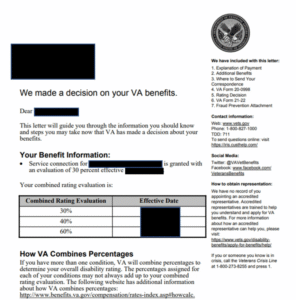
Think of this letter as a “report card” from the VA. It tells you their final decision after they review your information. The letter usually includes:
- The Decision: What percentage was potentially assigned to each condition.
- The Evidence: A list of the medical records and papers the VA looked at.
- Reasons for Decision: The “why” behind their choice.
- Favorable Findings: Facts the VA agreed were true, even if they didn’t grant everything.
Note: We are medical evidence consultants. We do not file claims, handle paperwork, or provide legal advice. Our goal is to help you understand what your medical records say so you can decide your own next steps.
Diagnosis vs. Service Connection: Why Both Matter
A common point of confusion is the difference between a medical diagnosis and “service connection.”
- Medical Diagnosis: This is a doctor saying you have a specific health issue, like a back injury or a breathing problem. It is a medical fact.
- Service Connection: This is the VA deciding if that health issue was caused or made worse by your military service. This is an administrative decision.
You can have a solid diagnosis from a doctor, but the VA may still decide there isn’t enough evidence to link it to your service. Your decision letter will explain if the VA found a “nexus” (a link) between the two.
| Feature | Medical Diagnosis | VA Service Connection |
| Who makes it? | A Medical Doctor | The VA |
| What does it prove? | That you are sick or hurt | That it happened because of service |
| Evidence used | Exams, X-rays, Tests | Medical records + Military records |
The “Domino Effect” in Your Health
Sometimes, one health issue leads to another. We call this the “Domino Effect.” In the VA world, this is known as a secondary condition.
Imagine a row of dominoes. The first domino is your main injury (like a knee problem). Because your knee hurts, you walk differently. Over time, that change in how you walk causes back pain.
- First Domino: Knee injury (Primary).
- Second Domino: Back pain caused by the knee (Secondary).
Your VA Rating Decision Letter might show that the VA saw the first domino but missed the second one. High-quality medical documentation can potentially show how these “dominoes” are connected.

How to Find and Read Your Letter
Possibly the easiest way to get your letter is online.
- Log in to VA.gov: Use your ID.me or Login.gov account.
- Go to “Disability”: Look for the “Check Your Decision Status” tool.
- Download PDF: Most veterans can see their letters here 7 to 10 days before they arrive in the mail.
Where to focus your eyes: Skip to the “Reasons for Decision” section. This is the heart of the letter. If the VA says they “did not find a link to service,” it may mean your medical records weren’t clear enough. This is where medical evidence consulting may be able to help.
Why We Ask for Your Decision Letter
At Trajector Medical, we ask to see your letter because it tells us exactly what the VA is thinking. By reviewing the VA’s own words, we can help you find:
- Missing Evidence: Did the VA miss a key doctor’s note you sent?
- Medical Nuance: Did the VA use a generic description for a very specific health issue?
- Clarification Gaps: Do your current records clearly explain your symptoms?
You are always in the driver’s seat. We provide the medical insights, but you decide if or how you want to use them in your benefits journey. We do not “prep” you for exams; we educate you on what the medical records show.
Your benefits journey is personal. The VA Rating Decision Letter importance lies in its ability to show you the path forward. By focusing on strong medical evidence and clear documentation, you can potentially provide the VA with the full picture of your health.